Recognised botanical identity
Green tea offers a familiar plant story suitable for active-lifestyle, antioxidant and weight-management category concepts.
 Get a Quote →
BOTANICAL & METABOLIC · INGREDIENT DIRECTION
A concentrated Camellia sinensis ingredient defined by catechins, EGCG and caffeine—not by the words “green tea” alone.
Discuss this ingredient →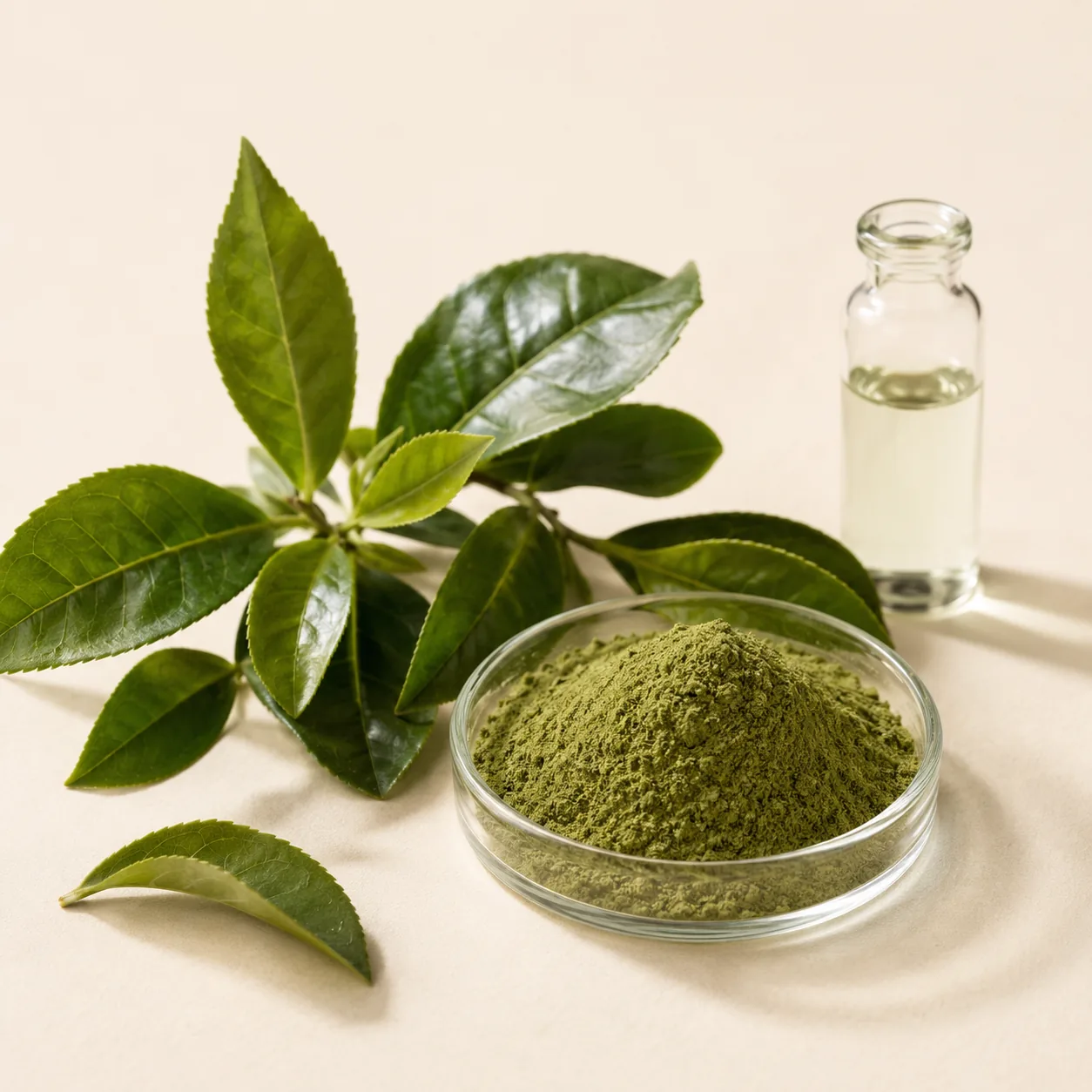
WHY BRANDS CONSIDER IT
Green tea offers a familiar plant story suitable for active-lifestyle, antioxidant and weight-management category concepts.
Total catechins and EGCG provide measurable markers for raw-material comparison, dosage calculation and quality control.
Different grades let brands control stimulant load, though decaffeinated does not necessarily mean completely caffeine-free.
INGREDIENT REALITY
Green tea extract is made from unfermented leaves of Camellia sinensis. Its principal polyphenols are catechins, including epigallocatechin gallate (EGCG), while caffeine varies with raw material and processing.
Extracts can differ sharply in catechin concentration and serving exposure. A responsible specification states total polyphenols, total catechins, EGCG and caffeine using validated methods.
EVIDENCE IN CONTEXT
According to the NIH, green tea or its extracts may produce only a small amount of weight loss, with unclear clinical relevance. A concentrated extract should not be marketed as a guaranteed fat burner.
The evidence and safety profile depend on the actual catechin and EGCG exposure. Brewed tea experience cannot be used as a substitute for evaluating a concentrated supplement extract.
OEM / ODM DEVELOPMENT
These checkpoints help convert an ingredient idea into a reproducible specification, suitable dosage form and retail-ready product brief.
Set ranges for total polyphenols, catechins, EGCG and caffeine. Confirm identity, solvent system and stability method.
Calculate daily EGCG and caffeine across all servings and all formula sources, not only the headline green-tea amount.
Catechin-rich extracts are bitter and can darken. Evaluate coating, encapsulation and flavour masking in consumer formats.
Require pesticide, heavy-metal, microbiological and residual-solvent controls appropriate to a concentrated leaf extract.
SAFETY & COMPLIANCE NOTE
Concentrated green tea extracts have been associated with liver injury. EFSA reported signs of liver effects at supplemental intakes at or above 800 mg EGCG per day, while it could not establish a safe supplement dose. Daily exposure, food-status directions, warnings and market limits require specialist review.
Final formula, serving size, label claims and warnings must be assessed for the intended population and destination market. This ingredient page is for B2B product development and is not medical advice.AUTHORITATIVE READING
SUITABLE SUPPLEMENT FORMATS
Compare the dosage forms that fit this ingredient direction, then connect it with a functional positioning and private-label manufacturing route.
START A GREEN TEA EXTRACT PROJECT
Include your target market, intended function, preferred dosage form, key ingredients and expected order quantity.